With billions invested into the UK data center industry to “turbocharge” the sector, identifying the most efficient and sustainable cooling equipment has never been more critical. Balancing the surge in AI data centers with meeting net zero targets is a challenging task. At Excool, that’s what we do best.
Adaptability and scalability in cooling equipment is key to meeting the increasing demands and extreme heat generation the AI boom is causing. Liquid cooling is a non-negotiable to address these concerns.
Coolant Distribution Units (CDUs)
The core of any liquid cooling system is a CDU. CDUs ensure the system is operating at optimal efficiency by acting as the go-between the heat rejection plant and the critical load, regulating coolant temperatures, flow rates and pressure. What’s more, CDUs ensure an extra layer of safety and security for liquid cooling systems as they mitigate the risk of leaks, safeguard against over-heating and ensure the longevity of the IT equipment.
Excool’s CDU provides targeted thermal management for high-density applications, ensuring efficient and sustainable cooling for even the most demanding workloads. Our CDU is completely customisable to your bespoke requirements, thoughtfully crafted with the highest quality stainless-steel to maximise the unit’s reliability and longevity.
The Excool CDU is designed with sustainability at its core, supporting the adoption of eco-friendly coolant mixes like propylene. Our intelligent design anticipates and reacts with lightening-speed to the instantaneous challenges of high-density cooling, preventing high temperature spikes during large load steps or transient events.
Heat rejection plant
The next crucial step of an AI-ready cooling system is its heat rejection plant. Excool’s ModulR S-Series range of free cooling, air-cooled chillers are designed to expertly handle the high water and glycol mix temperature required for liquid-to-chip cooling.
The S-Series chillers are manufactured to the highest quality, utilising stainless steel frames. This ensures the life of the chiller matches life of the data center, even when exposed to severe environments. This is atypical of competitor manufacturers as exposure to harsh conditions associated with air-cooled chillers often causes corrosion of painted mild steel framework. The chillers are also load-operated prior to shipping to ensure swift on-site deployment.
The increase in liquid temperatures facilitated by high-power GPUs has led to greater opportunities for free cooling. By utilising free cooling, the chiller is able to operate without compressors, making it significantly more efficient and require a lot less maintenance. This minimises mechanical cooling and significantly reduces annual energy costs.
Managing residual heat
Although liquid cooling is rightfully hailed as the solution to managing AI compute, what is less often discussed is that most liquid-cooled systems are hybrid-cooled. This is due to the residual heat produced from liquid cooling equipment.
Embracing hybrid cooling is the key to unlocking sustainable scalability for AI data centers. Hybrid cooling leverages the strengths of both air and liquid technologies, creating a customised solution tailored to your specific requirements.
Using indirect evaporative cooling units as perimeter airside cooling removes the requirement for compressor chillers, meaning that the primary cooling loop for liquid cooling can operate at higher temperatures, giving a lot more flexibility to the heat rejection system selection and increasing the opportunities for heat recovery. Not only does this minimise mechanical cooling, it may then be possible to handle all the liquid-cooled heat rejection via cooling towers or adiabatic dry coolers, significantly improving the operational efficiency of the data center. Carefully considering the heat rejection system for the airside cooling allows for radically reduced CAPEX, reducing the number of chillers, pumping systems and other supporting infrastructure on site.
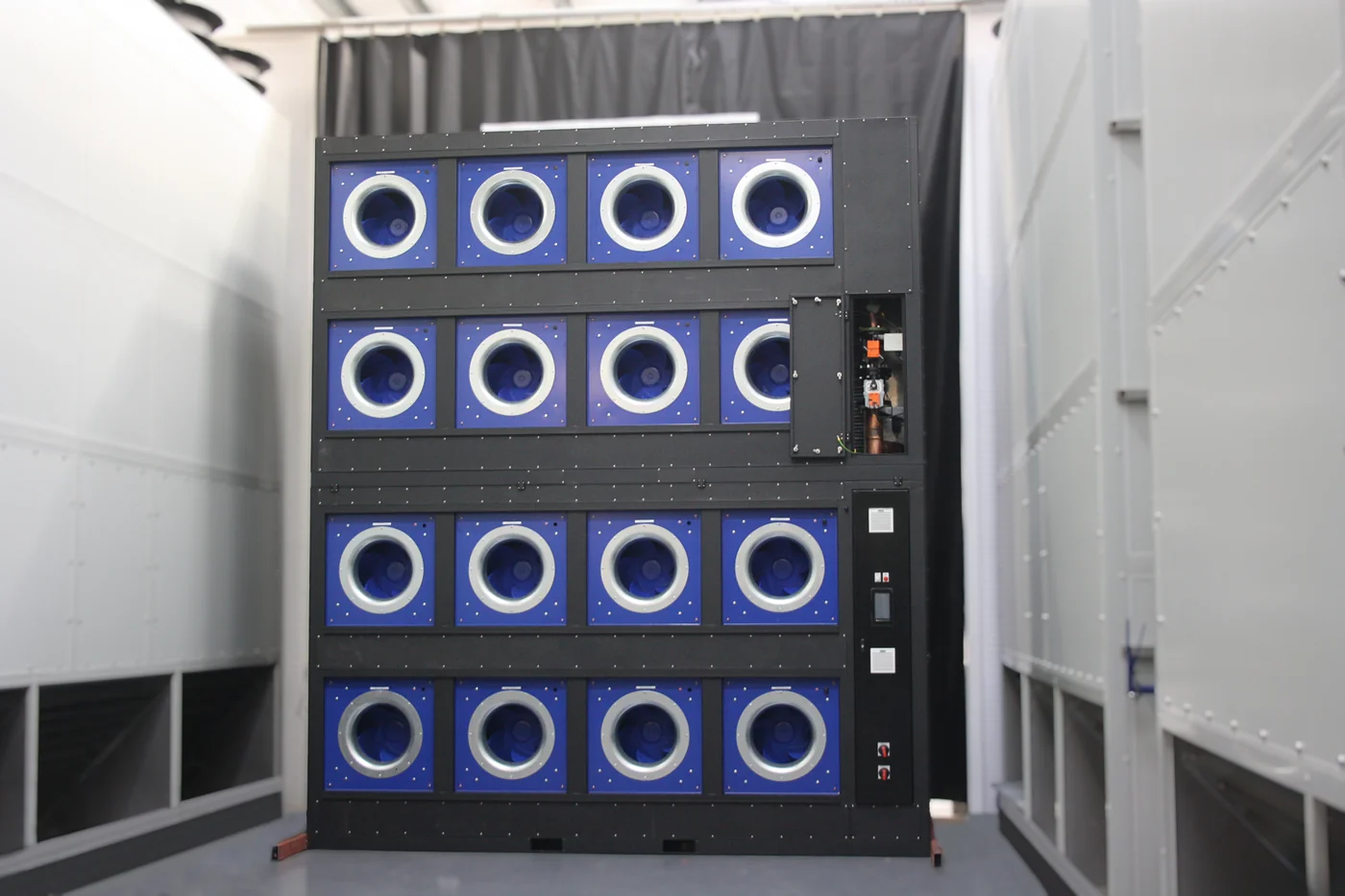
The Excool Zero uses an incredibly fine mist to harness all of the benefits of evaporative cooling, but with an astonishingly low PUE and up to a 90% reduction in water consumption. The Zero’s efficiency is enhanced by Excool’s propriety, non-corrosive heat-exchanger. What’s more, the units themselves are 30% smaller than the competition, all with its own water treatment and storage onboard, making it 25% more economical than comparative technology.